Showing posts with label society. Show all posts

Friday, 3 December 2010

Is the #turnred (RED) "AIDS-free generation by 2015" campaign lacking something?

As you may know, it was World AIDS Day yesterday, raising awareness of the global fight to eradicate the HIV/AIDS disease. I missed the day itself but was greeted by this popup today inviting me to "join RED" and help make the AIDS-free generation by 2015 a reality.

In case you're not familiar, RED is an initiative whereby you buy a particular variant of your product in red with a special (RED) brand - everything from iPods to shoes, clothing, coffee and books - and the manufacturer donates a portion (typically about 20%) to the global fight against AIDS (and possibly other causes as well, I'm not sure). Which is great, and they are having huge successes, having raised $160 million in 5 years.

I wholeheartedly support the goal of eradicating AIDS, and I love the idea of making such a bold statement that "We can have the first AIDS-free generation by 2015". But a number of things bugged me about this campaign.

1) The call to action is confusing

You click the banner and you are taken to this page. What does it want you to do? What does "join RED" mean? It turns out they want you to change your twitter avatar or facebook picture to the logo for the campaign. I thought I'd missed something, but after much searching this really does seem to be all they are asking people to do (and perhaps also to buy RED products). Is it just me or is this a bit odd?

2) When did social media attention become more important than money?

I can see that having people change their profiles on social media can help raise awareness (though perhaps not as much as the high profile stunts like lighting world buildings such as the Sydney Opera House and Harbour Bridge in red - see video here) but it's hardly the most valuable thing people can do. Surely the thing that will make the most difference is PEOPLE DONATING MONEY. And yet there is no facility to do that on the campaign's website. That is just ridiculous.

3) What's the basis for the statement that in 2015 we could have the first AIDS-free generation?

My first thought when I read the bold claim was, well that sounds great, but how are they going to do it? There's no information easily findable on the campaign site, or in most of the media coverage. It's completely not obvious where this claim comes from. Where's the science? Don't people care about science any more? Eventually I found a brief paragraph on the RED blog which explains that there is now medication available that can prevent HIV-positive mothers from passing the disease to their children, but that it is not always available. The implication is that the campaign can help with that.

Isn't that a pretty important fact for supporters to understand? Why is this barely covered anywhere?

4) How can people help make an AIDS-free generation a reality?

The question remains largely unanswered, by the campaign and even by high profile coverage like that on CNN. Is the best answer we can come up with "Buy more products but pick the ones with a (RED) logo?" It's a pretty sad state of affairs if that's the best society can do. Have we really become so capitalist that the only way we can mobilize people to helping a charity is to get them to buy more products?

Or by plastering their Twitter and Facebook profiles red? Is that the best we can do?

I think this is part of a disturbing trend. Ask people to do something trivial like that, and sure, they'll do it, you'll get lots of attention.. but nobody really made a difference by doing that did they? They might feel like they did but it's a meaningless gesture in terms of actually buying treatments and helping the lives of real AIDS sufferers.

I'm probably being controversial but I am appalled by how badly thought out this campaign is, and what it says about society. We have become the one-click generation. Click your mouse and you've done your bit, swipe your credit card and leave with a clear conscience. Perish the thought we might actually go out of our way to make some effort and really make a difference.

If you want to help fight AIDS, go and make a donation right now with an organization like the UK's National AIDS Trust. But don't think that you have made any difference at all if all you did was paint your profile red. 


Read more...

Friday, 19 March 2010

Jamie Oliver's Food Revolution is about to hit the USA - great to see social change in action!

You may have seen my earlier post about Jamie Oliver winning the TED prize with his campaign to teach every child about food. I've just watched the UK campaign, the TV show Ministry of Food (in the UK you can watch it online via that link) and it blew me away. It tells the story of the struggles and successes of how one man went to Rotherham, where hardly anyone cooks, and educated and inspired hundreds if not thousands of people to cook, and to teach others around them. Not to mention transforming a few individuals lives along the way. It's really quite inspiring to realize that one person can make a difference, especially if we all just do it instead of imagining failure. And it's great to see a celebrity use their influence as a force for good in the world.

Watching the show you really do get the sense that this is the beginning of a grassroots cultural revolution. People are starting to wake up to how badly we've been treating our bodies with the food we eat.

The campaign has already taken root in cities across the UK, with a new food education centre opened in Bradford, and the campaign is starting in Australia too.

If you're in the USA or Canada be sure to watch Food Revolution, where Jamie goes to the unhealthiest town in America - Huntingdon, West Virginia, and tries to start the revolution there. Trailer above, it starts on ABC next Friday 26th March with a preview this Sunday.

And if you want to get involved, and especially if you can't or don't cook, then just watch some of these simple video recipes, try them and most importantly, pass it on.

You can support the campaign here (for Americans) or here (for Brits).

Get involved, and maybe we really can solve the world's obesity problems, if not for this generation, then at least for our children.

(And I hope I am not being to preachy, but it's rare that you see something that is so overwhelmingly a good thing. I feel everyone should know about it!)

Update: You can also check out the things we can learn from this from a career perspective in this article.

Posted via web from Bowyer's Bite-size Blogettes


Read more...

Wednesday, 17 March 2010

Teach every child about food - Jamie Oliver's call to action (#TED)

Please, watch this video, and pass it to everyone you know.

Jamie Oliver has been awarded the TED Prize 2010 to help make his mission to re-educate society about the importance of home cooking, fresh food and eating well.

This is a solvable problem, which every one of us can help with. Sign up to help our children and our children's children - in the USA, the UK and around the world.

Posted via web from Bowyer's Bite-size Blogettes


Read more...

Thursday, 10 December 2009

Amazing stop motion video mashup - thanks to the BBC

The BBC has just done something revolutionary... they've released all the source footage for an as yet unscreened documentary about the way technology is changing our lives, and are inviting the public to compete and edit/mashup the footage into something unique. Above is an inspiring example of what's possible, by Barry Pilling. Here's another by Cassetteboy.
The idea of allowing your work to be edited and improved by others was first encouraged by the Creative Commons. If you don't already, make sure any photos you share on Flickr are released under Creative Commons, so others can do great things with them (without profiting or taking credit).
Another film in this vein that's well worth a look is RIP: A Remix Manifesto, the story of Girl Talk's rise to fame as a musician who plays no instrument but uses samples of others' music. It too is freely editable and mash-up-able. There's also a growing craze for "fake trailers", the most famous being Shining. It's so much easier these days now that people have a publishing house, editing studio and photo lab on their desktops. Exciting times!

Posted via web from Bowyer's Bite-size Blogettes


Read more...

Monday, 28 September 2009

What if we didn't need factories any more?

That is the thought-provoking possibility suggested by the RepRap project. RepRap is a simple 3D printer that can make plastic objects to any design, on your desk, using an ordinary PC. It can even make a copy of itself. It's entirely open source and freely distributable.

Ryerson University, the University of Western Ontario, Rabble and The Tyee have also started a very interesting multimedia project to explore this technology and the effects it will have on society further, called Maker Culture. You can read a good introduction by Wayne MacPhail here.

I am intrigued to see where this might lead. Developments in computing capability and internet technology have given us recording studios, photo labs, broadcasting studios, video editing suites and printing presses from our desktop - and have completely changed those industries as a result.

What changes can we expect in the world's manufacturing industries if goods no longer needed to be manufactured and distributed, but instead you downloaded a design and printed it yourself at home (much like you download an MP3 or movie and burn a CD or DVD now)?

Certainly this is a technology in its infancy, but full of promise. I can't wait to see how this develops.

Posted via web from Bowyer's Bite-size Blogettes


Read more...

Wednesday, 8 July 2009

An example of how society's values are all screwed up

The doorbell rang, a delivery man was there. "Sign here", he said, and handed me a cardboard box. "Thanks," I said, noticing how light it was. I knew I'd recently ordered two new hard drives and a SATA card (to connect them into our server). This was too light to be either.

You can see from the photos below what was inside - a box the size of two shoeboxes, stuffed with brown paper, containing 2 tiny red SATA cables (which could at a pinch fit in a normal paper envelope if you wanted to). I had ordered these from http://newegg.ca/ as part of the order for the SATA card. I was shocked that they would ship these individually and in such a wasteful way. A jiffy bag would have been more appropriate, and why on earth do the cables needed to be shipped separately.

This got me thinking, people talk about how we should have an economical model where we take into account the real environmental cost, not to mention the money cost. I can't think of a better illustration than this. Not only all that waste packaging, but the fact that the delivery man made a separate trip to deliver it.. Wasteful deliveries like this must equate to a lot of fuel, vehicle wear and tear, not to mention packing note printing, labour to package the thing, backroom admin by the supplier and the courier.

It's really sad that somebody decided it's "cheaper" to treat all items the same, send each part of an order in an identical size box, regardless of what it really needs or what is sensible.

I guess common sense doesn't scale.


Here's an image I found online which tells a similar story quite succinctly:


Posted via email from Bowyer's Bite-size Blogettes


Read more...

Monday, 9 March 2009

Living in bilingual city

"One man's fish is another man's poisson"

One of the things that has been particularly fascinating to me since arriving here is the way that language is used here in Montréal. It is the first time I have lived somewhere truly bilingual. Canada is officially a bilingual country, but Québec is an entirely French province. Some parts, like Québec City, have little difference from France. Montréal though has a fascinating mix of "Anglo" and French, along with many other nationalities, Jamaican and Arabic being some of the most prevalent. It even varies between parts of the city. Notre-Dame-de-Grace, where we live, is a very Anglo area, as are most parts West and South of the mountain. On the other hand, the Plateau, Outremont, and areas East and North of Mont Royal tend to be more French.

On first impressions, you would think that you were surrounded by French speakers, because all the signs, billboards, store fronts and even announcements on the Metro are in French. Most stores and businesses have different names here - Kentucky Fried Chicken is branded here as PFK (Poulet Frit de Kentucky) and Staples is Bureau en Gros (literally "Office Wholesale"). Business owners and restauranteurs will often greet you in French, and when you attempt to respond in French, they will continue to converse with you in French. And this isn't surprising since 70% of the population speak French as their first language.


Arret!
Uploaded to Flickr by caribb
But this is by no means the end of the story. It turns out that the reason everything is in French is because it is legally enforced to be that way. The Charter of the French Language was brought in by the Québec government in 1977 to enforce that all signage and information presented to the public shall be in French, or predominantly French! This means that if you wanted to open a business here, you couldn't call it "Dave's Sandwich Bar", you'd have to invent a French brand, "Chez David" perhaps, and you could only print the English text in a smaller font underneath. And in schools here, half of the day is taught in French, and half in English. All this was done to protect the language which was feared to be being lost due to the influence of American culture and language. So actually, when you look deeper, you realise that American culture is more prevalent than you might think. I'm also beginning to realise that "North American" (i.e. USA & Canada) is an identity and a culture in its own right - and while Canadians are not keen on the US, they are happy to be considered North American, and will sometimes even shorten this to American - which can be confusing!

What has amazed me is that everyone you encounter - from waitresses to bus drivers to even the homeless - can speak both English and French to some degree. And for the majority, they are pretty much fluent in both languages. As a result, there are some pretty strange customs about conversation, and you regularly see people swap language mid-conversation. Waitresses greet you with "Bonjour. Hi." so you can respond in French or English. The etiquette is that you should always respond in the language in which you are addressed - unless you really are not able to. This works two ways - if you go into a shop and ask a question in English, this is not as rude as it would be in France (although it does mean you will probably be considered a tourist). The person will respond and help you in fluent English (it might be a bit less fluent on the East side of the city though).

There's also this effect where people "size you up" to try and judge your likely language, and address you in that language.. sometimes getting it completely wrong, such as a checkout girl in Bouclair (a bit like the Pier) who was chatting to away her colleague in English as a native English speaker would, and completely threw us by turning around and addressing us in fluent French!

It turns out that the key thing here is understanding what's been said, and then it almost doesn't matter what language you respond in. I've even seen a mother and child conversing on the bus, where everything the daughter said was English, and everything the mother said was French. This was completely natural for them!

For my wife and I, the implications are somewhat different. For her, working in academia where English is the language of science, and being able to get served in English fairly reliably, means French is not as critical. For me, as someone who is likely to be working with people - and therefore could be addressed in French or English at any time, it is vital that I can understand and converse in French. So I've dusted off my 1995 A-Level and started putting it to use in everyday conversation. We've both found that when you're immersed in a language, a lot comes back to you, that you didn't think you knew. (Although it's not really a total immersion here - since you can switch out to English at any time).

Generally I've found my understanding is pretty good, I just need to sharpen up my vocabulary and pronunciation and gain a bit more confidence. Fortunately, as I mentioned in a previous post, I've been getting some French lessons, and I now have a second person I meet with for French conversation practice, which is particularly useful.

All in all, it's quite a unique environment to live in, and for me it reinforces the observation I made while in India last year - wherever you go, people are just people, with the same basic needs and desires - and language and cultural variation are just like layers masking that truth from being immediately obvious. I hope that in future as the world becomes more globalized, more people will become aware of this and just maybe, there could then be a little less trouble between nations and religions.

Update: I have just remembered something I intended to write with this post but forgot to include. I was thinking about how I might explain what it feels like here in terms of the balance between North American, French, and European influences. Here's what I came up with. If I wanted to create a city that felt like Montréal, here's what I'd do. Take one US city, with a lot of space and low population density. Send all the Americans living there away to a quiet part of France for 10 years so they become fluent in French and European in attitudes (They'd probably take their holidays in the UK and lose a few Americanisms too). Meanwhile, move a city full of French people into the city, so that they set up French businesses, infrastructure, signage etc. Make sure that they do business with the US and so they will have to become fluent in English as well. Pick a nice old city in France and select some of the nicest 100-200 year old buildings and transport them brick by brick to the center of this new city, to make it feel more French (this will be the old town). Now after the French have been in the city for 10 years and adapted themselves to North American culture, bring the Europeanised Americans back to integrate with the Americanised French. Let them set up their businesses in the city but only if done in a French way, or at least a more European way than they would in the US (although they can still link in with their business contacts and chains back in the US). Leave everything to blend for another ten years and there you have it. That's what Montréal feels like to me. An American city, with a layer of French culture and history, with a mix of English & French language, a mix of American and French businesses, and full of bilinguals, some more French, some more Anglo, but all of whom are more European in manner than American but yet have all adapted to a North American way of life!


Read more...

Monday, 3 November 2008

A feast for the senses; a land at peace

India 10: Reflections on India

So, my three week trip to India is nearing its end. Tomorrow I fly back to Mumbai and on Wednesday back home. As I reflect on my time in India my feelings are overwhelmingly positive. From day one, India has blown away all expectations. I have to confess I was pretty prejudiced about India. I imagined a disease ridden place with rubbish and bodies in the streets and destitute people all around. I couldn't have been more wrong. Yes there is more rubbish than you would see elsewhere - but not in the streets, the people are very proud and streets and highways are regularly swept clean. You have to look hard to see the rubbish - down back alleys and at the edges of towns. There are no bodies in the street either. That seems to be pure myth. The only thing we did see occasionally is sarcophaguses of mummified religious leaders by the roadside, as sort of shrines.

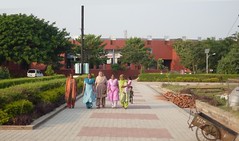
The most significant thing that strikes me about India is the colours. England and the West looks positively drab by comparison. Everywhere you look, bold bright colours can be seen. Women dress in striking coloured sarees to go about their daily business - even the poorest women still look beautifully dressed.

And it doesn't stop at the women. Buildings and office blocks are painted in bright reds, yellows and blues. Store fronts are decorated with fresh flower garlands each day. Even the vehicles are painted and adorned with flowers over their radiators. People decorate the entrances to their homes with intricate rangolis made from flower petals and pulses (and even more so at Diwali).

And it's not just colours, you find all your senses overwhelmed - smells of spices and freshly cooked curries mixed with incense and earthy farmyard type smells as well the occasional smell of bad drains. And vehicle horns mingle with traders and taxi drivers hollering each other along with occasional religious chants and calls to prayer from loudspeakers above temples. Even the temples are varied, a fusion of Islam and Hindu styles. And the taste too - The curries we have at home are not a patch on real Indian food. There is no "curry powder" here. Each dish is delicately crafted with the precise mix of chillies herbs and spices to complement its ingredients.

India is definitely a shock, but in a good way. It is unlike anywhere I've been before. Each place took a while to get used to, and I realised that a big reason for this is that India is really 28 different countries with various climates, cultures and languages - united mainly by proximity and religion. I had not realised that most Indians speak the language of their own state and one or two others - and only if you're lucky a basic level of Hindu and English. Both Hindu and English are the unifying languages but only the highly educated are fluent in either.

The thing that will stay with me most though is memories of the people here. Not are they incredibly warm and welcoming, they are more peaceful than any I've ever seen before. I saw no crime in India. Outside of tourist hotspots I saw minimal begging. What beggars you do see tend to put on an act and do it in tourist areas to earn a living, because they can earn more money that way, sadly. People wave as you pass by and greet you in the street. Everyone here just seems happy. And I literally mean everyone. We are glum by comparison.

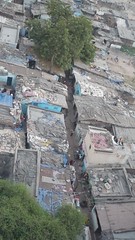
It started to dawn on me when I looked at the "slum" outside my hotel in Ahmedabad, and on closer inspection I realised that while these people had little money, they were getting on with their lives. They had very basic rooves above their heads, and electricity and water. They keep their streets between the tin huts clean, and their kids play happily outside. This was not a slum as I'd imagined it, from African famine appeals and Geography textbooks. These were proud people going about their business. Maybe the climate helps, but it just felt like there is a kind of positivity - everyone just gets on with life.

I think it really hit me though when we were driving into Mumbai from the airport and waiting in traffic. I saw a young girl of eight or so by the roadside. She was naked but for a pair of red shorts and had a pail of water by her, from which she was filling a small jug. She was rinsing and squeezing her clothes and then wringing them out on the pavement. She finished one garment and hung it on the railings by the roadside, and started on the next. I didn't feel horrified, and I wasn't sure why - surely I should be appalled at such a scene? But thinking about it afterwards I realised - that girl is not starving or malnourished, she is not begging, she has not given up on life. She was completely at ease with what she was doing. It was just part of her routine. And I think this sums up what the Indian people are about. Whether it comes from the belief in Karma, I don't know, but it seems that in India, you make the best of what life gives you. People don't spend all their time obsessing about how to make a better life for themselves. Which isn't to say they have no ambition - just that they maintain a happy and balanced outlook.

It's a really noble thing in a way, and it really makes you think about how we live our lives in the West. In general, we spend our lives in pursuit of more wealth or better partners, or we worry about fear losing what we already have. We obsess over what-ifs and might-have-beens without ever stopping to just enjoy what life has given us. I know that is probably a great over-simplification but I hope you can see what I am getting at. There is something we can learn from India. It's no wonder they are an up and coming force in the world. It's a country that's going places and which by and large hasn't been sucked into Western capitalist and media ideals (yet - I did see a few disturbing adverts for "skin whitening moisturiser" on the TV, and Mumbai feels quite a lot like other Western cities). I hope that as India grows to join the bigger, more "developed" nations of the world, it retains its vibrancy and individuality.

So that about sums it up, really. If you get chance, go to India, and leave your expectations behind. Go with an open mind and after a few days acclimatisation you will find a friendly place full of happy people, bright colours, great food and a rich history and culture. I know I'll be back.


Read more...

Thursday, 30 October 2008

Look at the strange cow-eating white men!

India 4: Strangers in a strange land

From the first night Steve and I went for a walk around Ahmedabad, we noticed that people were looking at us a little strangely. Not with any kind of negativity or judgement but more a sort of genuine fascination - the way you might find your eyes drawn to a person with bright green hair or an unfortunate birthmark. It took a little getting used to. After a couple of days it struck us - we were the only white people in town - even in the hotel. It seems the local people rarely see any non-Indians.

It turns out that Westerners rarely come to Gujarat, so in a way it was the ideal introduction to India. We realised just how rare it must be when we asked a rickshaw driver to take us to Le Meridien and he'd never heard of it or been there, even after we got there (Le Meridien is the most expensive hotel in town).

But it was also interesting to realise that we'd been there a couple of days without even realising we were in a minority. I found that quite weird at the time - my last experience of being in a minority was in Atlanta, Georgia, USA where everyone was black. I felt quite nervous and like I stood out, I was acutely aware of being different. Not so here. There's something about the people and their attitude that makes you feel very safe and at ease. It would take me a couple more weeks of being in India to really be able to put it into words.

On our first evening as we sat in a restaurant a little Indian girl of 10 or so years old and said in her best attempt at English. "Hello. What is your name?". Her mother stood behind her and looked on proudly. We introduced ourselves, asked her name, exchanged smiles and she went away happy. This sort of thing happened all the time.. Children would call out "Hello How Are You" in the street as we walked past. We even had a few shouts of "Welcome to India!" which was really touching. But this was nothing compared to what happened to us at Lothal.

It was our weekend off and we had a driver for the weekend. On the Saturday he'd taken us to some nearby sights - Akshardam Temple, Adalaj Step Well (which is a truly unique kind of below-ground temple or baoli which I had never seen before), Indroda Nature Park and Gujarat Science City. On the Sunday we headed further afield, south to the ruins at Lothal, and north to Modhera Sun Temple, both of which were well worth visiting.

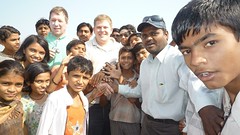
Lothal is a remnant of the Indus Valley civilization which existed around 2600BC - comparable to ancient Egypt. There is not a great deal left, lots of floors and walls - kind of like visiting a Roman fort on Hadrian's Wall. What is impressive is that they had shipping and docks with a form of lock all that time ago - and the dock is still water bearing. Also the kiln-fired red bricks they made over 4000 years ago are still intact and look even better quality than those we use today! (Apparently the British thought so when colonizing the area and helped themselves to plenty - as did local farmers etc). Anyway I digress. Not long after we'd arrived at the site, a school bus pulled up. The kids spotted us and started hanging out of the windows cheering and waving. Lothal is out in the countryside and these kids must rarely see anyone outside their own village let alone from another country.

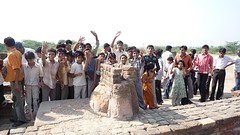
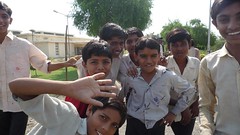
Not long after they were off the bus they ran to see us - they were far more interested in us than the ruins. They swarmed around us all wanted to shake our hands - at one point I had about 15 hands on my arm as they all tried to touch me! They all wanted to be photographed, taking great pleasure in being photographed - as do most of the children in India, they often ask to be photographed and giggle when you photograph them. A world away from the UK where photographing children is so heavily frowned upon. The school teacher with the group was just as excited as the kids, but spoke reasonably good English and talked to us about the children and his school. As a teacher he earns 2000 rupees a month (approx 23 GBP) but said that the children come from very poor farming families where there parents earn a fraction of that.

He had one of the group take our photograph with the schoolkids on an ancient-looking film camera, a picture for their classroom. He also asked for our autographs and asked if he could "interview" us. The interview consisted of one question, "What do you eat for lunch in India?" I'd actually had a lot of local foods and Gujarati Thali so I thought I'd say something more unusual to them - I said "burger and chips". He had literally no idea what this was, and asked me to write it down. It's nice to see that there are some parts of the world where fast food culture has not yet arrived! After a while, a few more handshakes and a few more photographs, he managed to tear the group away from us and get them back to their historical education.

It was an unbelievable experience I will never forget. You hear people talk of people in remote parts of the world getting excited when they see white people but I'd never seen it for myself first hand. I gave a few of the kids some English 10p and 20p coins I had left in my wallet - something from the West - it made their day! The whole experience left us feeling warm and fuzzy for the rest of the day!

We went to a restaurant in Ahmedabad for lunch, and a group of college age girls asked us where we were from and what we were doing here. We explained we were from England and were working here. They said they were studying for MBAs - which explained their good English. Generally we observed that the more educated people in India spoke English (hoteliers, teachers, students etc) but the more menial workers (drivers, shopkeepers etc) rarely spoke any.

Throughout the rest of our time in Gujarat, and to a lesser extent in Mumbai and Goa, people would come up to us and ask where we are from. We'd say England, and they'd walk away smiling. I found it a bit odd at first that people would ask our country then that would be the end of the conversation. But an incident at the airport gave me an insight into this. Steve spotted a very dark skinned man who stood out from the Indians, and asked him where he was from. The man said Nigeria, and Steve smiled and the conversation ended. I just realised I'd seen the same conversation in reverse - it's simply that we are so out-of-the-ordinary to the local people, that they are just compelled to find out where we are from!

Another bizarre celebrity-type moment happened to me at Shanku Water Park, where a group of boys dragged me into the "wet disco" (basically an outdoor room with loud music and water jets spraying from the floor. They proceeded to dance around me cheering and jumping around like I was a rock star and making "rap fingers" gestures. At the other side of the room, a group of girls danced in their own little huddle, wearing long sleeved pyjama-style swimsuits. It was a very very weird experience!


Read more...

Friday, 11 July 2008

Is the increase in choice bad for society?

"Content is King"

Since getting my N95 8Gb I've been listening to a lot more podcasts (I set them to download overnight) and have been particularly enjoying Stephen Fry's Podgrams, which are basically random musings by Stephen Fry, who I've always found intelligent and witty in equal measures, a rare combination. I'm met him too and he is very down-to-earth. Anyway, this isn't a Stephen Fry fan blog, I have a serious discussion point to raise, so without further ado..

Podgram #4 "Broadcasting" consists of Stephen delivering a speech that he gave in response to OFCOM's proposal that the UK TV licence fee should be shared between the BBC, Channel 4, ITV and five. (For more info on this, check out these links - [1],[2],[3]). This is a worthy topic for debate in its own right, I can see both sides but ultimately think it's a bad idea and would agree with the point of view "If it ain't broke, don't fix it"

The thing that I found most thought provoking though, was not the licence fee issue, but the idea that "Content is King". Stephen talked a lot about this; the idea that we have completely changed the way we consume recorded content - be it television, film, radio, podcasts, music or audiobooks. He makes the point that we do not think in "channels" any more, thanks to 24 hour channels, digital TV and its hundreds of niche channels, PVR systems, DVD-rental-by-post services, digital downloads, torrents, podcasts, iPlayer and the like.. As viewers we simply seek out the content we are interested in, get hold of it in whatever form we can, and watch it. In general, we do not care about a channel in its own right, we are far more interested in particular shows or types of shows that appeal to our interests. Hence the phrase "Content is King".

Stephen argues (I hope I'm summarizing his view correctly) that this is not a good direction for television, and that the BBC is one of the last channels that people have brand loyalty to because of its reputation for good quality programming across a wide range of areas - not just the big audience "entertainment" shows like Doctor Who and Strictly Come Dancing, but wildlife shows, current affairs, documentaries, science, religion, arts, music etc. He argues that this would be eroded by the so-called "top-slicing" of licence fee revenue, because we then would be totally abandoning the idea of channels, abandoning the BBC as a viewing destination in its own right and reducing it to a producer of public service content.

He paints a picture of a future world where there are no broadcast channels - everyone has their own "narrowcast" personalised channels, with only those shows they like, catered to their exact demographic and interests, with advertising tailored to them. You can really see this happening already, with services like TiVo in the broadcast space, and with RSS aggregators for podcasts & blogs in the Internet space. The only real difference is that we form our personalised channels manually at the moment, by our selections from the plethora of content that is out there. It won't be long before it's done for us (TiVo is already ahead of the game on this one).

This really struck a chord for me, especially when I consider how my own viewing habits have changed since Sky+, V+ and BitTorrent. I'd already observed that I really don't watch live TV anymore - with all the Series Links I have set up, as well as the shows I can only get via BitTorrent (such as Lost), I have such a choice of things I am interested in, which I rarely get to the end of, and this has meant far less "random" viewing - I watch a lot more of the things I know, and a lot less of the things I don't. At first glance this seems a good thing, but if I'm honest I know that I watch far fewer documentaries, current affairs programmes and the like, even though I sometimes set series links - because why would I watch Dispatches or Newsnight when I have a backlog of The Gadget Show, Top Gear, QI or The Apprentice to watch? I am as guilty as anyone else of going for a short term highs rather than something that will be more mentally exercising but better for broadening my knowledge.

It's when I think of this in terms of how much entertainment television is now watched versus "public service" programming (think of the rising popularity of Big Brother, X Factor and Shipwrecked and the declining audiences for current affairs programmes), and the wider picture of how these changes affect society as a whole, that I begin to be a bit more concerned..

Personalization of content - More of what we want, but at what cost?

The whole point of public service broadcasting is that it raises the level of education of the population, covering issues and spreading knowledge on topics that would be not be commercially viable to produce programming about. For this to succeed, it seems there needs to be some element of "chance discovery" of content - like when you turn to a channel you know produces good content, like the BBC, and find something interesting that you weren't looking for. I'd not really thought about it from this angle before, but it seems that this is something that we are all overlooking with the abundance of seductive and appealing content before us, not just in broadcast media but on the Internet too. (Maybe this partly explains the appeal of StumbleUpon!) We need exposure to things we were not seeking and did not know about, in order to challenge our thinking, expose us to new ideas and general broaden our minds.

And there may be other disadvantages too, to the personalization of content - because the more we are drawn to specific interests, given the raise of social media, we are likely to form communities around those interests as well... So the viewers of a highly personalised channel, be it fishing channel, a goth music channel, a single mums' channel, a Christian prayer channel or a new age spiritualist channel, will form communities around those channels and only interact with those people and those ideas. And just like we see ethnic minorities or social classes clustering in certain areas of cities, seldom mixing outside those circles, we will start to see an intellectual, or rather an "information" segregation, where people polarize into different specialized groups that do not cross paths or spread knowledge, potentially resulting in even more segregation, discrimination and "tribal" problems. This can't be a good thing for society.

This struck me as a really important message - and I know I have gone way beyond the point of Stephen's speech, but for me this debate about public service broadcasting and the BBC licence fee was just the tip of the iceberg - This "Content is King" ethos that we all eagerly feed on, perhaps without realising, is something that could spell a real "dumbing down" of society if left unchecked. We need to make sure we continue to be exposed to new ideas, unfamiliar subjects and a balance of public service and entertainment content. And we need to remember that more and more content on the Internet is written by individuals or corporations with their own agendas, and thus, the truth will be harder to find. (Relevant book: Cult of the Amateur - I confess I haven't read it yet)

Choice in news media - is it a good thing?

So, we can now see that the abundance of choice we have today encourages us to select & personalise content we find most attractive, and that while this has advantages it also has some dangers to society as a whole.

It seems to me that there are other potential pitfalls of too much choice, particularly when you look at the effect that 24 hours news channels and websites have had on the quality of journalistic output, and on public opinion.

Overwhelmed with news stories, and often feeling too busy to read stories in depth, it seems we often believe that which is easiest to believe - a story about someone who is being questioned in connected to a crime, gets summarized as "so and so is guilty of that crime", and then that story spreads around the net, and before you know it, the person is guilty. The truth as commonly believed and the truth as based on actual facts, diverge. We are no longer innocent until proven guilty. Similarly, a story about a scientific development gets exaggerated by the media, and by people believing what they want to believe - extrapolating an early step in the right direction through to the technology that might be possible if developed further (e.g. "OMG! Scientists invent Holodeck")

Is society dumbing down?

In our rush to consume as much information as possible in a an ever growing sea of information and content, we over-summarize and cut corners. We forward heartfelt e-mails of tragedies and brushes with death without checking them for authenticity or accuracy. It's ironic really that the the Internet gives us more power to research the accuracy of information, and yet we seem even more inclined to just believe what we read without doing so. Children are losing the skills to analyse the relevance and accuracy of information.

Negative feedback loops

It's really concerning to me as well, how there is now a feedback loop between media stories and reality itself. 24 hours news reports come out every hour for days that Northern Rock is in crisis - and a panic is created, making a possibly recoverable problem into an unrecoverable situation that spreads out to affect the whole industry.

Newspapers report that a politician is "tonight under intense pressure to resign" even though he only pressure is from the media, suddenly they are under intense pressure, and resign. TV reports that "people are up in arms about a possible emissions tax" and people are put off the idea before they even get the chance to work out the facts of how it will actually affect them. Constant reports of problems in the property market make people even less inclined to buy property than they were before. Collectively, the media and newspaper outlets notice (or create?) trends in public opinion or public behaviour, and report them in a sensationalised, exaggerated way, designed to have the maximum emotional impact, because the most sensational stories are those that will be easiest to digest, and will stick in our minds most - this usually means those stories most likely to induce negative emotions such as outrage, distrust, fear or disgust (Good news reporting has died out) Before you know it, the media reports has affected what people behave, which in turn affects how we act, and what started as nothing more than a story or an idea has actually affected the reality of the situation itself. It's like some sort of societal version of Heisenberg's uncertainty principle.

The other effect of this is that even though there is more choice of media sources, there is less breadth in coverage, everyone jumps on the bandwagon and the same stories get regurgitated for weeks on end (think Princess Diana inquests, 10p tax rates or Madeline McCann hunts - Was the public really so interested in those stories or was it just the media getting into a frenzy and feeding off each other?).

The media believe they are giving us what we want, so they produce more of the same, and the repetition of the same type of stories again and again forms a vicious circle, reinforcing the nation's out-of-proportion obsessions with child protection, fear of terrorists, suspicion of immigrants, distrust of government, and so on.. (I recommend Noam Chomsky's book Media Control for more on this topic)

In summary

It must be time for me to get off my soapbox now! :-) I hope that I am wrong that the overwhelming choice we have won't mean the dumbing down of society, and that we can find a way to be less affected by media coverage in what we think and believe.. I'm very interested in noticing trends in society and this does seem to be one possible way things could go if we continue on the current course. Let me know what you think!

Disclaimer: This is very much an opinion piece, which I will have on my blog from time to time. It is not my intent to force my point of view - just to share ideas & stimulate debate - which I welcome through the comments, whether you share my concerns or think I've got it all wrong, provided it remains courteous! I look forward to reading your comments!


Read more...