Showing posts with label people. Show all posts

Monday, 3 November 2008

A feast for the senses; a land at peace

India 10: Reflections on India
So, my three week trip to India is nearing its end. Tomorrow I fly back to Mumbai and on Wednesday back home. As I reflect on my time in India my feelings are overwhelmingly positive. From day one, India has blown away all expectations. I have to confess I was pretty prejudiced about India. I imagined a disease ridden place with rubbish and bodies in the streets and destitute people all around. I couldn't have been more wrong. Yes there is more rubbish than you would see elsewhere - but not in the streets, the people are very proud and streets and highways are regularly swept clean. You have to look hard to see the rubbish - down back alleys and at the edges of towns. There are no bodies in the street either. That seems to be pure myth. The only thing we did see occasionally is sarcophaguses of mummified religious leaders by the roadside, as sort of shrines.

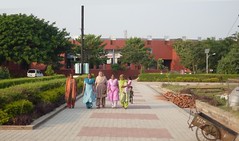
The most significant thing that strikes me about India is the colours. England and the West looks positively drab by comparison. Everywhere you look, bold bright colours can be seen. Women dress in striking coloured sarees to go about their daily business - even the poorest women still look beautifully dressed.

And it doesn't stop at the women. Buildings and office blocks are painted in bright reds, yellows and blues. Store fronts are decorated with fresh flower garlands each day. Even the vehicles are painted and adorned with flowers over their radiators. People decorate the entrances to their homes with intricate rangolis made from flower petals and pulses (and even more so at Diwali).

And it's not just colours, you find all your senses overwhelmed - smells of spices and freshly cooked curries mixed with incense and earthy farmyard type smells as well the occasional smell of bad drains. And vehicle horns mingle with traders and taxi drivers hollering each other along with occasional religious chants and calls to prayer from loudspeakers above temples. Even the temples are varied, a fusion of Islam and Hindu styles. And the taste too - The curries we have at home are not a patch on real Indian food. There is no "curry powder" here. Each dish is delicately crafted with the precise mix of chillies herbs and spices to complement its ingredients.

India is definitely a shock, but in a good way. It is unlike anywhere I've been before. Each place took a while to get used to, and I realised that a big reason for this is that India is really 28 different countries with various climates, cultures and languages - united mainly by proximity and religion. I had not realised that most Indians speak the language of their own state and one or two others - and only if you're lucky a basic level of Hindu and English. Both Hindu and English are the unifying languages but only the highly educated are fluent in either.

The thing that will stay with me most though is memories of the people here. Not are they incredibly warm and welcoming, they are more peaceful than any I've ever seen before. I saw no crime in India. Outside of tourist hotspots I saw minimal begging. What beggars you do see tend to put on an act and do it in tourist areas to earn a living, because they can earn more money that way, sadly. People wave as you pass by and greet you in the street. Everyone here just seems happy. And I literally mean everyone. We are glum by comparison.

It started to dawn on me when I looked at the "slum" outside my hotel in Ahmedabad, and on closer inspection I realised that while these people had little money, they were getting on with their lives. They had very basic rooves above their heads, and electricity and water. They keep their streets between the tin huts clean, and their kids play happily outside. This was not a slum as I'd imagined it, from African famine appeals and Geography textbooks. These were proud people going about their business. Maybe the climate helps, but it just felt like there is a kind of positivity - everyone just gets on with life.
I think it really hit me though when we were driving into Mumbai from the airport and waiting in traffic. I saw a young girl of eight or so by the roadside. She was naked but for a pair of red shorts and had a pail of water by her, from which she was filling a small jug. She was rinsing and squeezing her clothes and then wringing them out on the pavement. She finished one garment and hung it on the railings by the roadside, and started on the next. I didn't feel horrified, and I wasn't sure why - surely I should be appalled at such a scene? But thinking about it afterwards I realised - that girl is not starving or malnourished, she is not begging, she has not given up on life. She was completely at ease with what she was doing. It was just part of her routine. And I think this sums up what the Indian people are about. Whether it comes from the belief in Karma, I don't know, but it seems that in India, you make the best of what life gives you. People don't spend all their time obsessing about how to make a better life for themselves. Which isn't to say they have no ambition - just that they maintain a happy and balanced outlook.

It's a really noble thing in a way, and it really makes you think about how we live our lives in the West. In general, we spend our lives in pursuit of more wealth or better partners, or we worry about fear losing what we already have. We obsess over what-ifs and might-have-beens without ever stopping to just enjoy what life has given us. I know that is probably a great over-simplification but I hope you can see what I am getting at. There is something we can learn from India. It's no wonder they are an up and coming force in the world. It's a country that's going places and which by and large hasn't been sucked into Western capitalist and media ideals (yet - I did see a few disturbing adverts for "skin whitening moisturiser" on the TV, and Mumbai feels quite a lot like other Western cities). I hope that as India grows to join the bigger, more "developed" nations of the world, it retains its vibrancy and individuality.

So that about sums it up, really. If you get chance, go to India, and leave your expectations behind. Go with an open mind and after a few days acclimatisation you will find a friendly place full of happy people, bright colours, great food and a rich history and culture. I know I'll be back.


Read more...

Thursday, 30 October 2008

Look at the strange cow-eating white men!

India 4: Strangers in a strange land

From the first night Steve and I went for a walk around Ahmedabad, we noticed that people were looking at us a little strangely. Not with any kind of negativity or judgement but more a sort of genuine fascination - the way you might find your eyes drawn to a person with bright green hair or an unfortunate birthmark. It took a little getting used to. After a couple of days it struck us - we were the only white people in town - even in the hotel. It seems the local people rarely see any non-Indians.

It turns out that Westerners rarely come to Gujarat, so in a way it was the ideal introduction to India. We realised just how rare it must be when we asked a rickshaw driver to take us to Le Meridien and he'd never heard of it or been there, even after we got there (Le Meridien is the most expensive hotel in town).

But it was also interesting to realise that we'd been there a couple of days without even realising we were in a minority. I found that quite weird at the time - my last experience of being in a minority was in Atlanta, Georgia, USA where everyone was black. I felt quite nervous and like I stood out, I was acutely aware of being different. Not so here. There's something about the people and their attitude that makes you feel very safe and at ease. It would take me a couple more weeks of being in India to really be able to put it into words.

On our first evening as we sat in a restaurant a little Indian girl of 10 or so years old and said in her best attempt at English. "Hello. What is your name?". Her mother stood behind her and looked on proudly. We introduced ourselves, asked her name, exchanged smiles and she went away happy. This sort of thing happened all the time.. Children would call out "Hello How Are You" in the street as we walked past. We even had a few shouts of "Welcome to India!" which was really touching. But this was nothing compared to what happened to us at Lothal.

It was our weekend off and we had a driver for the weekend. On the Saturday he'd taken us to some nearby sights - Akshardam Temple, Adalaj Step Well (which is a truly unique kind of below-ground temple or baoli which I had never seen before), Indroda Nature Park and Gujarat Science City. On the Sunday we headed further afield, south to the ruins at Lothal, and north to Modhera Sun Temple, both of which were well worth visiting.

Lothal is a remnant of the Indus Valley civilization which existed around 2600BC - comparable to ancient Egypt. There is not a great deal left, lots of floors and walls - kind of like visiting a Roman fort on Hadrian's Wall. What is impressive is that they had shipping and docks with a form of lock all that time ago - and the dock is still water bearing. Also the kiln-fired red bricks they made over 4000 years ago are still intact and look even better quality than those we use today! (Apparently the British thought so when colonizing the area and helped themselves to plenty - as did local farmers etc). Anyway I digress. Not long after we'd arrived at the site, a school bus pulled up. The kids spotted us and started hanging out of the windows cheering and waving. Lothal is out in the countryside and these kids must rarely see anyone outside their own village let alone from another country.

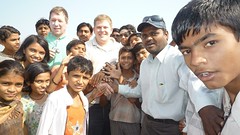
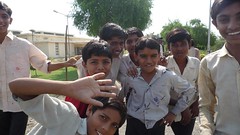
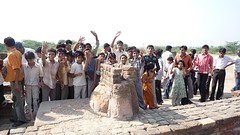
Not long after they were off the bus they ran to see us - they were far more interested in us than the ruins. They swarmed around us all wanted to shake our hands - at one point I had about 15 hands on my arm as they all tried to touch me! They all wanted to be photographed, taking great pleasure in being photographed - as do most of the children in India, they often ask to be photographed and giggle when you photograph them. A world away from the UK where photographing children is so heavily frowned upon. The school teacher with the group was just as excited as the kids, but spoke reasonably good English and talked to us about the children and his school. As a teacher he earns 2000 rupees a month (approx 23 GBP) but said that the children come from very poor farming families where there parents earn a fraction of that.

He had one of the group take our photograph with the schoolkids on an ancient-looking film camera, a picture for their classroom. He also asked for our autographs and asked if he could "interview" us. The interview consisted of one question, "What do you eat for lunch in India?" I'd actually had a lot of local foods and Gujarati Thali so I thought I'd say something more unusual to them - I said "burger and chips". He had literally no idea what this was, and asked me to write it down. It's nice to see that there are some parts of the world where fast food culture has not yet arrived! After a while, a few more handshakes and a few more photographs, he managed to tear the group away from us and get them back to their historical education.

It was an unbelievable experience I will never forget. You hear people talk of people in remote parts of the world getting excited when they see white people but I'd never seen it for myself first hand. I gave a few of the kids some English 10p and 20p coins I had left in my wallet - something from the West - it made their day! The whole experience left us feeling warm and fuzzy for the rest of the day!

We went to a restaurant in Ahmedabad for lunch, and a group of college age girls asked us where we were from and what we were doing here. We explained we were from England and were working here. They said they were studying for MBAs - which explained their good English. Generally we observed that the more educated people in India spoke English (hoteliers, teachers, students etc) but the more menial workers (drivers, shopkeepers etc) rarely spoke any.

Throughout the rest of our time in Gujarat, and to a lesser extent in Mumbai and Goa, people would come up to us and ask where we are from. We'd say England, and they'd walk away smiling. I found it a bit odd at first that people would ask our country then that would be the end of the conversation. But an incident at the airport gave me an insight into this. Steve spotted a very dark skinned man who stood out from the Indians, and asked him where he was from. The man said Nigeria, and Steve smiled and the conversation ended. I just realised I'd seen the same conversation in reverse - it's simply that we are so out-of-the-ordinary to the local people, that they are just compelled to find out where we are from!

Another bizarre celebrity-type moment happened to me at Shanku Water Park, where a group of boys dragged me into the "wet disco" (basically an outdoor room with loud music and water jets spraying from the floor. They proceeded to dance around me cheering and jumping around like I was a rock star and making "rap fingers" gestures. At the other side of the room, a group of girls danced in their own little huddle, wearing long sleeved pyjama-style swimsuits. It was a very very weird experience!


Read more...