Showing posts with label travel. Show all posts

Saturday, 20 March 2010

Travel Bite #4: Hotel Avante, Mountain View

I'm currently spending a couple of days relaxing in the Bay Area after attending the Cloud Connect conference. Usually I'd write about places I've been and sights I've seen, but I thought for a change I'd blog about the hotel I am staying in - Hotel Avante in Mountain View. I got my stay here through the cheap hotel site hotwire, for a very reasonable $59 (39GBP) a night. One of the things about Hotwire is you get cheap prices but you don't find out the hotel until after you book (by area) - so I would never have known about this place - but boy am I glad I did. It's probably the best hotel I've ever stayed in!

So, what makes this hotel so special? The first thing you notice is the lobby, with comfortable sofas, reading tables stacked with copies of Time and Wired (this is Silicon Valley after all).


There is a sort of postmodern ambience about the place - retro typewriters and old cameras nestle alongside light orbs and funky modern art. The elevator doors are even a work of art in their own right.

I checked in and was very impressed on entering my hotel room. I flipped on the light switch by the door and was pleased to see a centre ceiling light which really illuminated the whole room - none of this running around the room to switch lamps on like most dingier hotel rooms.


And then I saw the desk... It has two glass panels to see into the drawers below. One drawer contains stationery and practical items.


The other is chock full of "executive toys" - a Slinky, an Etch a Sketch, some transparent playing cards, a Rubik's cube.


The hotel notepad says "IDEAS" over the top, with a stylized human brain. As someone who likes to get creative and innovative, I love this!

Everything about the room has been carefully thought out. There are two surge-protected power strips, so none of the usual contest for sockets.


The bedside table has a recessed area right by the pillow holding another ideas pad - perfect for late night inspiration or dream recording! 


I've been here over 24 hours now, and I'm still discovering new things.. A shelf in the cupboard contains some stick magnets and ball bearings to play with.


A hi-fi with a library of CDs you can borrow from the front desk. Toothbrush and toothpaste provided. The bedside table, as well as the requisite Holy Bible, contains a torch/flashlight and emergency flare - how random! The hotel TV is HD, and swivels around so you can watch it while working at the desk.


Speaking of which, the wi-fi is complimentary and fast. In fact there are four different wi-fi networks to choose from! This includes Google's free wide area wi-fi network serving the whole of Mountain View. We are in the home of the Googleplex here!

There is a great little outdoor swimming pool and hot tub/jacuzzi.

And a fitness room, and a relaxation lounge.

The bed is a very comfortable king-size, with more cushions and pillows than you could ever wish for. Every evening there is a complimentary happy hour bar, and the hotel lobby has a wine rack and every room has a corkscrew - no need to go out for supplies! This morning I had breakfast, which was a buffet with everything I could have wished for - eggs, sausages, bacon, pancakes, fresh fruit, bagels, toast, yogurts, cereals, pastries, juices & hot drinks. And what's more - it's free! This is almost unheard of in the US in my experience - most free breakfasts are continental and most cooked breakfasts cost extra.

The hotel is well located too - with plenty of stores, restaurants and bars in walking or driving distance along the road - the hotel is located on El Camino Real. And there's plenty to see in the area.. Silicon Valley, NASA Ames Center, the Computer History Museumthe Star Trek exhibition at The Tech in San Jose, Stanford University, and lots of great open spaces and countryside.

So why is this hotel so good? There is a sign outside the elevators with the hotel motto - they aim for your stay to be "Better than Expected".
And trust me, it really was! This is a great example of applying "Made to Stick" principles - making a clear, concise message for the employees to hold on to.

You can see some more photos at a higher resolution on my Flickr page.

Here's some more links to find out more:

Posted via email from Bowyer's Bite-size Blogettes


Read more...

Sunday, 7 February 2010

Travel Bite #3: Tulum, Mexico

Over the Christmas 2005 / New Year 2006 period, we spent three weeks in Central America. One of the highlights was Tulum,  about 80 miles south of the not-worth-visiting tourist metropolis of Cancun on the Yucatan peninsula.

From the main hostel area in Tulum Pueblo (the village of Tulum) it's only 70 pesos for a short taxi ride to the entrance of Tulum Ruinas, the Mayan walled city (or a long dusty walk which was the option we chose unfortunately!). The site, also known as Zama (City of Dawn) was one of the last outposts of Mayan civilization, being occupied from around 1200AD all the way through to the Spanish colonization in the 16th century which marked the end of this 3,500 year old empire.

As we walked down the dusty track we saw stalls and traders selling colourful ponchos, rugs and sombreros as well as faded postcards and tacky replica Mayan ruins.


I bought a fresh coconut and enjoyed the juice, something I hadn't done since my last trip to Malaysia in 2004. One trader beckoned me over and starting bargaining with me; he literally wanted the shirt off my back - as it was a genuine Premiership Southampton shirt.


He offered me rugs and other colourful weavings. Ultimately I said no, he had nothing I wanted. It was entertaining though - I guess there are some things money can't buy in Mexico!


The ruins themselves were magnificent. Not the towering pyramids we'd seen in Chitchen Itza or Tikal, but low rectangular pillared buildings with a unique style something between Roman and Ancient Egyptian.


They had stepped rooves and looked quite dramatic against the lush green grass of the hilltop. As we wandered among the ruins on paths we saw maybe thirty or forty iguanas, each one a good two or three feet long. They looked like they owned the place, perching on the rocky ruins.


Being a lizard fan, Alex was in her element and managed to snap some amazing photographs, as you can see.


We reached the cliff edge and were treated to picture-postcard views of pure white sands and azure blue waters down at the base of the cliffs. The fort certainly had an imposing location perched a hundred feet up!


We headed down the steps to the beach and indulged in a swim. The sand was soft and the water was warm. It was hard to believe it was early January. We were very glad to have chosen Tulum over Cancun. 


We headed back up through the ruins and then walked down the beach - Tulum Playa - past expensive resorts and restaurants, admiring the beautiful ocean view.


We rounded off the afternoon with a smoothie in a seafront bar and found our way back to the main road and back into the village.

You can see the hi-resolution photos on Flickr here.

You can learn more about Tulum via these links:


Posted via email from Bowyer's Bite-size Blogettes


Read more...

Saturday, 16 January 2010

Travel Bite #2: Lake Champlain and a taste of New England

Back in May last year we picked up a Communauto car and did a day trip down into New England. We went down the western side of the massive Lake Champlain through New York State and back up the eastern side through Vermont.

We headed south over the border on Interstate 97 and stopped at a tourist information centre soon after where were able to pick up some useful maps and leaflets. We drove further south and were treated to impressive views of the Adirondack mountains towering overhead, which we plan to visit someday as well as the nearby Lake Placid. We had planned to stop first in Plattsburgh (which incidentally is supposed to be a good location for cheap flights across the USA, as many of the budget airlines don't fly to Canada).

Unfortunately not long after we got over the border the heavens opened, so rather than stop we continued south along the 9 and more minor roads by the edge of the lake (which is technically a very large river).


We saw some beautiful houses on the waterfront. As we have seen in most places in North America, waterfront access is often difficult as it tends to be private land - unlike the UK where rights of way and footpaths exist by most lakes and rivers. One house had a beautiful little summer house on stilts on the water with a hammock looking out onto the lake - it made you wish you lived there!


By now the rain had stopped and we spent some time walking down the streets and to the water's edge in a beautiful little village called Essex, where there seemed to be a very sleepy pace of life and fog engulfed the end of the pier.


Outside of the village we stopped at our first US "historic site", a tiny limestone school house from 1816 (photo on Flickr - see below).

We continued south down long and winding (but nonetheless attractive) roads until soon after Port Henry, were we began to head Northeast, and took the Champlain Bridge across into Vermont.


By now the rain had stopped and the sun came out, treating us to some beautiful views over green fields and of attractive wooden farmhouses with pill shaped grain silos.

We stopped at an interesting art gallery/antiquities store and then continued further north until we reached the city of Burlington, which was surprisingly attractive and felt quite British with ice-cream kiosks, clothes stores and pedestrianised streets. We wandered through a shopping centre and stopped for tea and cake at the excellent Dobra Tea where you can sample teas from every country in the world accompanied by delicious salads, snacks and pastries.

We then began to head home, taking the scenic route across the islands through the agricultural settlements of South Hero, North Hero and Alburgh.


The light was amazing as the afternoon drew to a close, making some wonderful reflections on the water and making the trees and grass seem a lush yellowy green.


We crossed back into Canada on a minor road near Rouses Point, which was pretty much one guy in a booth - a much more pleasant experience than our crossing south on the Interstate (and no queue).


The whole trip was about 4.5 hours driving. It was great to get a taster of the areas around Lake Champlain and we left feeling that there's plenty more for us to explore next time. All in all, a great day out, despite the rain. You can see our route here:

You can see higher resolution photos in the full set on Flickr here.

You can find more information about the area via the following links:


Read more...

Sunday, 10 January 2010

Travel Bite #1: A winter drive through the Eastern Sierra, USA

Welcome to the first of my "travel bites" - short travelogues focussing on a particular place I've been.
In mid-December Mrs. Alex and I took a road trip through a large chunk of southwestern USA. For me the highlight was the spectacular scenery we encountered as we drove down US 395 through the Eastern Sierra, from Lake Tahoe past Mono Lake and onwards south into the Owens Valley and then east towards Death Valley.

Lake Tahoe
We arrived in Lake Tahoe just before sunset, having taken route 50 east from Sacramento.


We found a waterfront park, closed for the season but accessible on foot. We trudged across the snow covered sand to the water's edge and watched the sun go down.


Carson City & Lake Topaz
After dark we drove to Carson City, a sort of Blackpool version of Las Vegas, where we spent the night in a motel that seemed to have been left unchanged since the 80s. The next morning we set out early and headed south, dipping in and out of fog-filled valleys. Snow capped peaks were all around us as we descended below the cloud layer at Lake Topaz.


The lake was half covered in thick ice with ice crystals sparkling in the bright morning sun.


The ice was so thick we even ventured out onto the lake, and felt like we could have walked further still!


Mono Lake & Lee Vining
We continued south, stopping regularly for photos as each corner revealed ever more impressive snow-covered landscapes. The roads were clear and empty despite guidebook warnings of impassable roads. Soon we approached an even vaster misty valley, that of Mono Lake.


Here the overnight fog had allowed ice crystals to gather on every tree branch and flora, creating an incredible winter wonderland.


We wandered around the cemetery, and imagined ourselves in Narnia.


After a brunch stop at the excellent Nicely's diner in Lee Vining, we drove round to the south side of the lake to see the Tufa. The road down to the water's edge was inaccessible, but we got close enough to see the tufa (salty stalagmite-like deposits rising from the lake), and even heard two coyotes howling in the distance. We could just make them out.


Inyo Forest, Mammoth and Owens Valley
Continuing through the Inyo Forest region we neared the Mammoth ski area. This side road and a couple of other scenic loops were inaccessible without snow chains.


But we didn't care as we were seeing plenty of amazing scenery.


We passed through the town of Bishop and were amazed by the view as the landscape opened out into the vast Owens Valley. This was one of those views impressive in its vastness to which a camera just cannot do justice. We had started to lose altitude now, and it was warm enough in the sunshine to build a mini-snowman and have a little snowball fight.


We drove further on as the snows began to disappear and be replaced by grasslands and then desert as we headed east on the 190 towards Death Valley... but that's a story for another travel bite!

All in all we spent probably 5 to 6 hours driving, plus lots of stops, and it was a drive I would recommend to anyone, particularly in this quiet winter period.

Photos, Links, and Map
As well as the photos above, you can view more images with high resolution versions on Flickr:
You can see our route on this map (you'll need to zoom out a bit):

I plan to make these travel bites a regular feature, so let me know what you think!


Read more...

Sunday, 4 October 2009

Canada, land of empty spaces and vast distances

Canada is overwhelmingly big. The distances and emptiness are awesome in the truest sense of the word. I knew this on some level, but it wasn't until I tried to explore some of it with my family that it began to sink in. Subsequently I did some digging online that gave me an even stronger sense of just how empty it really is. I learnt about many remote places and how hard they are to visit. Eventually I even found an excellent graphic illustrating how most of Canada is uninhabited, which you can find at the bottom of this article.

A week "in Gaspé"
At the start of September, my parents came to visit for a couple of weeks. We decided this was a great opportunity to explore a bit of Canada together, so set aside a week for what would be our biggest trip yet since moving here - exploring the Gaspé peninsula. We got to Quebec City fairly quickly and had a pleasant overnight stay there. In the morning we stopped for a brief look at Montmorency Falls, then crossed back to the peninsula and headed upriver along the Route des Navigateurs.


View Gaspé Trip in a larger map

Our journey took us past plenty of beautiful little villages and farming communities along the way and enjoyed stopping for picnics and photographs. But after a long day's driving, we only got as far as Le Bic, just barely inside the Gaspé region. It dawned on us that with only seven days available, the only way to get around the peninsula would be to drive for long periods every single day - which wouldn't leave us much time for sightseeing. So we adjusted our plans to be less ambitious.

We camped the next night in the gorgeous Le Bic National Park (see left), where we hired bikes and had some lovely walks. The next day, rather than continuing along the north coast, we cut across the peninsula, and stayed the next two nights at the very strange castle-hostel Chateau Bahia. We used this as a base to explore the Restigouche region on the south of the peninsula. Alex and I spent a day kayaking down the crystal clear Matapédia river and we visited more seaside towns, such as Carleton-sur-mer. Then it was time to start heading back towards Montréal, which we did via a lunch stop on the US border at St Leonard in New Brunswick, and an overnight stop in Magog in the Eastern Townships (which were unfortunately rather wet). We arrived back in Montréal on the seventh day, having had a great holiday. We'd driven 1,781 kilometres, or 1,106 miles! For more details on the trip and some photos you can check out Mrs Alex's blog (ask me for the link) - plus I will be putting up photos on Flickr at some point.

Thinking about visiting the wilderness

The trip to Gaspé was a real eye-opener to me. I'm keen to explore Canada, and especially to see some of the more "wild" parts. What I'm beginning to realise is that in a country this big, that's just not so practical. The Gaspé peninsula is relatively "local" for us - yet it needs half a week just to get there and two to three weeks to enjoy it properly. I've spent several evenings browsing the map of Canada on Google Maps, clicking places that look interesting - and every time I look at the logistics of how to get to these places, I am amazed at just how inaccessible much of the Canadian wilderness is. I suppose that's why they call it wilderness!

For example, while doing a bit of Google earth exploring, I discovered Lake Manicougan, a perfect crater lake, apparently not too far from here. Maybe that could be worth a visit? I then read an account from a couple who went kayaking there and realised just how huge and far away it is. It's a mere 1,071 kilometres (666 miles) from Montréal. The last 85km of that is on unfinished roads, and when you get there, there are no facilities. So in theory that would be possible for us, if a little awkward - but like the Gaspé trip, it would take over a week to do it justice. When you have limited vacation days in a year, such epic quests would burn up your leave in no time!

Here's another example. My Lonely Planet 2009 calendar on the "Canada" page shows a picture of a beautiful mountain reflected in a lake. The caption reads "Mount Magog, reflected in Mount Assiniboine Provincial Park" (see right). I couldn't even find this mountain on Google (most of the hits are for another with the same name in Utah). When I did find the page about Mount Assiniboine Provincial Park I read such encouraging words as "No roads penetrate this unspoiled wilderness, with trails providing the only land access" and "Visitors are reminded that the park is a wilderness area, without supplies or equipment of any kind". I don't think I'll be visiting there soon then!

Ever since I saw Canada in an atlas at school, I was impressed by the size of Hudson's Bay. So being in Canada now, I wondered about whether it might be possible to visit Hudson's Bay. I scrolled around the map and noticed the Polar Bear Provincial Park, a nice green area on the south of the bay. On further investigation I found that "it has no visitor facilities, is reachable only by air, and special permission is required before visiting it." Looking back at the map confirmed it - no roads! Hmm, maybe not then!

It occurred to me that the Hudson's Bay Company (which is still trading today and is older than Canada by the way!) was built on harvesting the resources of Hudson's Bay - surely there must be some access to the Bay. This led me to learn about York Factory, which used to be their headquarters, but is more or less abandoned now, and only accessible by water or air anyway.

Through further investigation I found out about the James Bay Road, built to access Hydro Electric facilities built near the Bay in the 1970s. The James Bay Road is pretty much the only road access to Hudson's Bay (James Bay is the southern-most inlet of Hudson's Bay). Surprisingly, it's quite a well built road, but it will take you 27 hours to get all the way along it (from Ottawa), and for 381km there are no services or settlements! Here are a few interesting accounts of people who've travelled the James Bay Road - one, two, three, four. The roadside photo to the right is from another account for which I have unfortunately lost the link.

As you can see, I'm beginning to understand just how vast and undeveloped much of Canada is. I've also learned more about the vast emptiness of Canada from TV series such as the recent Channel 4/National Geographic series Alone in the Wild, where Ed Wardle survives on his own for 50 days in the wilderness of the Yukon. The History Channel/Five series Ice Road Truckers taught me about the ice roads in Canada's northwest territory, which only exist during the winter months as vital supply lines to communities and mining outposts in the far North, that are completely isolated for most of the year.

I could go on, but I won't. I have now realised that the only way to visit some of these places is to invest serious chunks of time - weeks if not months - in other words, not when you have a regular job. And you need a shedload of cash too - not just for transport and accommodation, but for vital equipment for survival! Here is a map showing many of these inaccessible places I've learnt about (click a feature for more info):


View Inaccessible Places in a larger map

So, just how empty is Canada?

As you can see this is something I've been thinking about a lot. But my curious mind then started wondering.. how empty is Canada? I had lots of fun playing with the population density table on Wikipedia, which you can sort in different ways; it turns out Canada has on average 3 people per square kilometre, compared to 31 in the US or 246 in the UK. Of 238 countries in the world, it ranks 231st lowest for population density, beaten only by the likes of Australia, the Sahara and Mongolia.

There's an oft-quoted statistic about how three-quarters of the population of Canada live within 90 miles of the US border. But I wanted to know more - which parts of Canada are uninhabited? Apparently this is quite a difficult question to answer, but eventually I came across a study by Statistics Canada that, in exploring different methods and representations, came up with a rather excellent depiction of "The Population Ecumene of Canada". Ecumene is a word of Greek origin referring to the "inhabited earth". Here is their map:


(click for a larger version or here to see the original in context)

In this map, the green parts are the main inhabited areas, the red spots are small pockets of civilization outside the main parts, and the white and grey parts are completely uninhabited.

I find this absolutely breathtaking. Huge extents of Canada are totally devoid of civilization. Most Canadian provinces have only a handful of settlements and the rest is totally undeveloped. What I find particularly interesting is that unlike Australia or the Sahara, there is still a lot of Canada that could be inhabited - just that it would cost a great deal to develop the necessary infrastructure to support it. A large part of Canada is made up of the Canadian Shield, which is covered by lakes, forests and is high in mineral deposits. Winters are tough but except for the far North, no worse than other inhabited parts of Canada. I think that perhaps the reason these places have not developed, is not anything about the land itself, just a lack of proximity to the existing civilized world, making supplies and trade difficult.

It's strange really. I guess that colonization of uninhabited land and creating new settlements isn't really viable in today's economic climate. I suppose this is what the rest of the world was like before we built our cities and transport networks. And I wonder if some time in the future, greater parts of Canada will become inhabited and enjoyed by ordinary folks, or whether it will always be mostly an unspoilt wilderness that only the intrepid can visit.


Read more...

Thursday, 28 May 2009

Las Vegas, city of excess

Business pleasure or pleasure?

Las Vegas is a strange place, I think it's the nearest you can get to what you might imagine a parallel universe to be. An hedonistic alternate reality where society is dedicated to the pursuit of pleasure, and nothing else matters. Big corporations own big hotels & casinos, theatres and night entertainment venues, all designed to separate you from your hard-earned cash in exchange for giving you some great experiences.

I found myself somewhat in conflict at first in Las Vegas; I loathe the incessant commercialism of corporate America, avoiding McDonalds or Disney as much as I can. I hate tourist tat and tourist gimmicks. So by all reasonable logic I should have hated Las Vegas - as the epitomy of everything I think is wrong with the world. But somehow I didn't. I actually really liked it. And it took me a long time to figure out why.


I think it comes down to the way that tourism operates in Las Vegas. Elsewhere, say a theme park, you'd see a lot of cheapy plasticky attractions, and ill-conceived marketing slogans that constantly remind you that while you may be enjoying yourself, your money is being extracted from you at every opportunity.

In Vegas, on the other hand, it's as if money is no object. The hotel casinos are palatial. There are stately homes and castles with less marble flooring, with less ornate chandeliers, with much smaller floral displays and less beautiful hanging artwork. Everything is built to impress, to make you feel special. And it's not just the artwork too. We went to a burger bar one day, and were treated to a choice of four different types of beef, 4 different types of bun and a selection of twelve fillings. I was asked how I liked my burger cooked. It was a burger bar run by a gourmet professional chef. Nothing you experience in Vegas is ordinary. And yet at the same time, you rarely feel heavily sold to. It's almost as if money is a taboo in Las Vegas. Just have fun, just enjoy yourself, we don't need to worry about that crude money stuff. I know there's been research carried out that shows that people behave less wisely about money when the activities they are making decisions about are more removed from cold hard cash. I think Vegas is living proof of this. It's all about credit cards, poker chips, lines of credit, and bills that you are encouraged to just sign without thinking about.

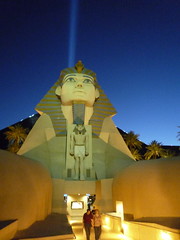
One of the most distinctive features of Las Vegas is the way that famous buildings and architectural styles of the world have been re-created. I stayed in the Luxor, a replica of an Egyptian Pyramid with a giant Sphinx in front. Throughout the hotel are giant pillars and statues and a cavernous interior. I've been to the real Pyramids of Giza. There is no question that it is a breathtaking sight and an impressive feat of engineering and at the same time, the Las Vegas version is impressive in its own way. It's almost as if it gives more of a sense of what it might have been like to be around in the time of the Pharoahs - not in a historical sense but in the sense that the place is alive and bustling and something more than just a building. It's a sense you get a lot in Las Vegas. You kind of feel like royalty, or at the very least, it makes you feel special and important.


The Venetian on Flickr
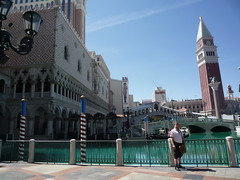
Down the road from the Luxor are the Eiffel Tower & the Arc de Triomphe (at the Paris Hotel), the Statue of Liberty and the New York skyline (at New York New York), and most impressive of all, are the very convincing replicas of Venice at the Venetian hotel. I couldn't quite believe it when I walked around the corner and found myself apparently on the Grand Canal. The quality of the replicas of the buildings is incredible. And the artificial canal with real singing gondoliers under a fake blue sky, indoors on the second floor of a shopping centre, has to be seen to be believed. Elsewhere in Vegas, in the Wynn hotel, there is a giant artificial waterfall, and a pair of curved escalators - if these are not impressive feats of engineering I don't know what are!

I've heard Las Vegas described as "Disneyland for grown-ups".. That's really not too far off. Instead of funfair rides and cartoon characters, Vegas has top quality shows, great restaurants, and huge bars and clubs. It's a place you can come and be a kid - spending time on just having fun - but just doing slightly more adult things.

Well, I haven't said a great deal about what I actually was doing in Vegas - helping to run the Enterprise Cloud Summit conference and liveblogging it on Bitcurrent. Nor have I talked much about the various social things we got up to - extravagant steak dinners, limo rides, dancing and drinking the nights away, and generally enjoying everything Vegas has to offer. Why? Well those things were what made the trip so enjoyable, I loved the Las Vegas party atmosphere - albeit I spent a lot more than I wanted to - but really, they're not going to be that interesting to read about. I really just wanted to share my thoughts about the weirdness and uniqueness and special qualities of the place. I did pretty much what everyone does who goes to Vegas - drank, gambled, ate well, stayed out too late and had a damn good time. If you want to see some photos you can take a look at my set on Flickr. But I don't need to go through those here. All I really want to say is, no matter what your tastes, don't write off Vegas. You just might be surprised.

I'll leave you with a quote from Norman Mailer:

"The night before I left Las Vegas I walked out in the desert to look at the moon. There was a jeweled city on the horizon, spires rising in the night, but the jewels were diadems of electric and the spires were the neon of signs ten storeys high."

By the way, you may also be interested to know that I have started a new, shorter blog at alexbowyer.posterous.com as an experiment in ways to get me blogging and writing more regularly. You can also access this by clicking "Blogettes" at the top of this blog.


Read more...